Reflection
Professional Reflection
A critical examination of my nursing practice, clinical growth, and the experiences that have shaped my professional identity as I work toward AHPRA registration.
Reflective Practice Video
A personal reflection on my nursing journey, clinical experiences, and professional development goals.
Professional reflection — Udani Rathnayaka, Master of Nursing
Written Reflection
The following reflection uses Gibbs' Reflective Cycle to examine a significant experience from my clinical placement in a residential aged-care facility. For confidentiality, the resident is referred to as Mr Adam.
During my clinical placement in a residential aged-care facility, I had an experience with a resident that made me think more deeply about dignity, independence and person-centred care. For confidentiality, I will refer to the resident as Mr Adam. I have used Gibbs' Reflective Cycle to guide this reflection because reflection can help nurses recognise what went well, what could be improved and how future practice can change (Barchard, 2022).
Description
During an early morning shift, I was allocated to assist Mr Adam with his activities of daily living, including showering, dressing and getting ready for breakfast. From handover, I knew that he usually liked to do as much as possible for himself and only needed help with some parts of his care.
At around 7:30 a.m., I knocked on his door, greeted him and explained that I had come to help him get ready for the day. Mr Adam was awake, but he stayed in bed and told me that he did not want a shower. I gently encouraged him and mentioned that breakfast would be served soon. However, he became more uncomfortable, pulled the blanket closer to himself and asked me to leave him alone.
At that point, I realised that continuing to encourage him might make the situation worse. I told him that it was okay and that I could come back later. I then informed my supervising nurse that he had declined his morning care.
About 40 minutes later, I returned to his room. This time, instead of immediately talking about his shower, I asked him how he was feeling. After a short conversation, he told me that he had experienced urinary incontinence overnight and felt embarrassed because his clothes and bedding were wet. He also said that he did not like other people doing everything for him because he had always been independent.
This helped me understand the situation in a completely different way. His refusal was not simply because he did not want care. He was embarrassed and seemed to be trying to protect his privacy and independence.
I asked him whether he would prefer to wash at the bathroom basin rather than have a full shower. I also reassured him that he could do as much as he wanted by himself and that I would only help where necessary. He agreed. I made sure the bathroom door was closed and gave him towels so that he could stay covered. He washed his face and upper body independently and chose his own clothes. I helped him only with the areas he found difficult and with dressing his lower body. Afterward, he appeared more relaxed and thanked me for not rushing him.
Feelings
At the beginning, I felt a little stressed because I knew I had several tasks to complete during the morning shift. As a student, I also wanted to show that I could manage my responsibilities well. When Mr Adam refused care, my first thought was that I might fall behind with my work. Looking back, I can see that I was focusing more on the task than on how he was feeling.
When he became uncomfortable after I encouraged him a second time, I felt unsure of myself. I started to realise that what I thought was gentle encouragement could still feel like pressure to him. After he explained what had happened overnight, I felt more understanding and empathetic. I could imagine how uncomfortable and embarrassed he may have felt. I also felt that I had learned something important — that personal care can be a very vulnerable experience for older people, especially when they have always valued their independence.
Evaluation
One thing I believe I did well was that I stopped when Mr Adam clearly said no. I did not continue trying to convince him. I respected his decision, gave him some space and informed my supervising nurse. This was important because older people in aged care have the right to make choices about their daily life and care. The strengthened Aged Care Quality Standards emphasise dignity, choice, independence and respect for individual preferences (Aged Care Quality and Safety Commission [ACQSC], 2025).
I also think my second approach was much better. Instead of going back and repeating the same request, I tried to understand how Mr Adam was feeling. This allowed him to explain what was really bothering him. However, I could have improved my first approach. I assumed that because it was morning, he should have a shower and get ready for breakfast. I was following the facility routine instead of first thinking about his individual preference. This experience reminded me that good aged care is not only about completing tasks. Quality care also includes dignity, respect, relationships and allowing older people to have choice and control over their care (Cleland et al., 2021).
Analysis
This experience helped me understand person-centred care in a more practical way. Person-centred care means seeing the resident as a whole person rather than focusing only on what care needs to be completed. Ebrahimi et al. (2021) explain that person-centred care for older people involves understanding the individual, including their values, preferences, goals and everyday routines.
At first, I saw the situation as simple: Mr Adam needed morning care, and he refused. After speaking with him, I realised that his refusal had a reason behind it. He was embarrassed, felt exposed and wanted to maintain some control over his situation. This made me realise that a refusal can sometimes be a form of communication. Instead of thinking that a resident is being difficult or uncooperative, it is important to think about what they may be trying to tell us.
Backhouse et al. (2020) found that individualised approaches and changes in the way personal care is offered may help reduce resistance to care in long-term care settings. Although their review mainly focused on residents living with dementia, the idea of adapting care to the individual was very relevant to Mr Adam's situation.
Mr Adam's comment about not wanting people to do everything for him stayed with me. It reminded me that independence can be very important to a person's identity. Even when someone needs help, they may still want to feel capable and involved. By allowing Mr Adam to wash parts of his body himself and choose his own clothes, I was supporting his independence rather than taking over. This is consistent with the current Aged Care Quality Standards, which emphasise supporting older people to make choices and maintain independence wherever possible (ACQSC, 2025).
This experience also helped me understand autonomy. Just because I believed having a shower would be good for Mr Adam did not mean that I could decide for him. In this situation, there was no immediate danger in delaying his shower. Respecting his choice was therefore more important than following the routine exactly. I also learned that privacy is especially important during personal care. Urinary incontinence can be embarrassing and upsetting. If I had rushed into care without understanding the situation, I might have made him feel even more uncomfortable.
The change in his behaviour after I slowed down and listened showed me how important communication can be. Once he felt that I was not going to pressure him, he became more open and willing to accept support. Reflective practice helped me recognise this more clearly. Barchard (2022) notes that reflection can help nurses identify assumptions and improve their approach to future situations.
Conclusion
This experience changed the way I think about residents who refuse care. Before this incident, I may have seen refusal mainly as a problem that needed to be solved. Now, I understand that there may be many reasons behind a person saying no. Mr Adam was not simply refusing hygiene care. He was embarrassed and wanted to maintain some independence and privacy.
The most important lesson I learned is that when a resident says no, I should not immediately try to persuade them. I should first respect their decision and try to understand what is behind it. Mr Adam eventually accepted care, but only after the approach changed. He was given time, privacy, choice and more control over how the care was provided. This showed me that good care is not just about completing a shower or getting a resident ready for breakfast. It is also about how the person feels during that care.
Action Plan
In future, if a resident refuses an activity of daily living, I will avoid assuming that they are being difficult or non-compliant. I will first respect their refusal and, when appropriate, ask gentle open-ended questions to understand the reason. I will consider whether pain, tiredness, embarrassment, incontinence, mood, privacy, cultural preferences or the timing of care may be affecting their decision.
I will also offer realistic choices, such as having care later, having a wash instead of a shower or allowing the resident to complete more of the activity independently. If the refusal is unusual, ongoing or linked with changes in the resident's health, I will report this to the supervising nurse and document it according to facility policy.
Most importantly, I will remember that the aged-care facility is the resident's home. My role is not just to complete a list of tasks. My role is to support the person in a way that protects their dignity, respects their choices and helps them maintain as much independence as possible.
References
- Aged Care Quality and Safety Commission. (2025). Standard 1: The individual. Australian Government. https://www.agedcarequality.gov.au/strengthened-quality-standards/individual
- Backhouse, T., Dudzinski, E., Killett, A., & Mioshi, E. (2020). Strategies and interventions to reduce or manage refusals in personal care in dementia: A systematic review. International Journal of Nursing Studies, 109, 103640. https://doi.org/10.1016/j.ijnurstu.2020.103640
- Barchard, F. (2022). Exploring the role of reflection in nurse education and practice. Nursing Standard, 37(6), 45–49. https://doi.org/10.7748/ns.2022.e11605
- Cleland, J., Hutchinson, C., Khadka, J., Milte, R., & Ratcliffe, J. (2021). What defines quality of care for older people in aged care? A comprehensive literature review. Geriatrics & Gerontology International, 21(9), 765–778. https://doi.org/10.1111/ggi.14231
- Ebrahimi, Z., Patel, H., Wijk, H., Ekman, I., & Olaya-Contreras, P. (2021). A systematic review on implementation of person-centered care interventions for older people in out-of-hospital settings. Geriatric Nursing, 42(1), 213–224. https://doi.org/10.1016/j.gerinurse.2020.08.004
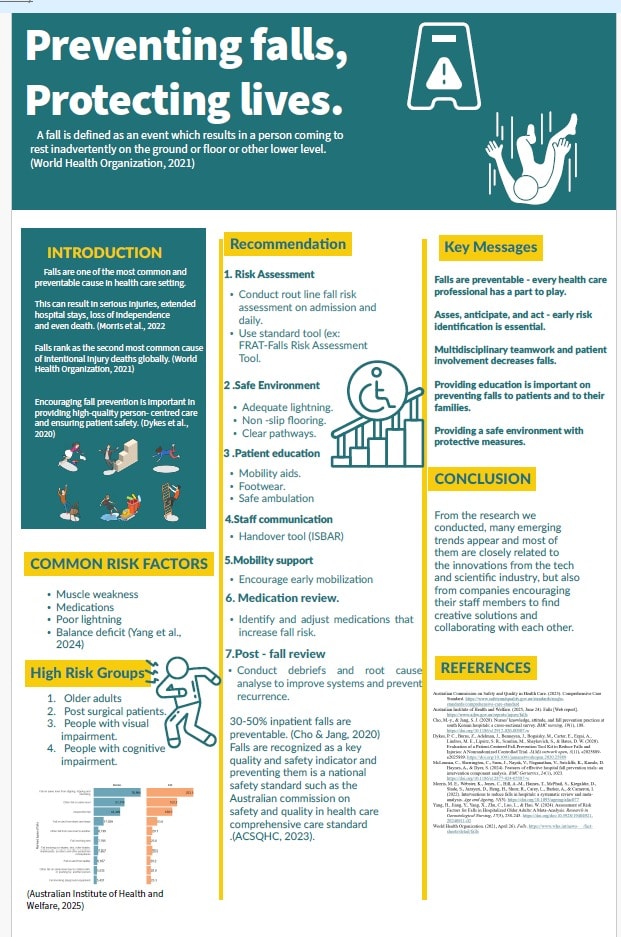
E-Poster
A visual summary of key clinical insights from my nursing practice.